


A revolutionary method that has gained prominence in the quick-changing and fast-paced field of software development is the Microservices Architecture. Microservices architecture is a revolutionary and essential method that enables developers to create applications that are both scalable and agile. Microservices, which originated from domain-driven design, infrastructure automation, and continuous delivery, are one of the many architectural patterns that have gained a lot of attention and traction over the years.
Posted by nirasystems
Microservice in .Net Core
- December 27, 2023
- 8 min read
Principles of Microservices
Microservices architecture is built on several key principles that guide its design and implementation:
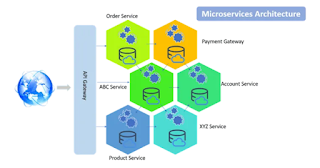
- Failure Isolation: The isolation of failures is emphasized in microservices design. An application can be divided into smaller, autonomous microservices so that problems only affect that one service and don't affect the system as a whole. This improves fault tolerance and guarantees that in the event of a single service failure, the system as a whole stays stable.
- Independent Deployment: The capacity to launch and update individual microservices is a key component of microservices architecture. This gives developers the freedom to update or add functionality without impacting the overall application. Rapid iteration and a speedier reaction to evolving requirements are made possible by independent deployment.
- Modeled around Business Domain: Particular business domains or functionalities are heavily considered throughout the design process of microservices. Every microservice takes care of a specific business function, which makes it simpler to understand, create, and manage. By coordinating development efforts with business requirements, this domain-centric strategy enhances flexibility and agility.
- Encapsulation of Implementation Details: The encapsulation of implementation details within individual services is encouraged by microservices. A microservice merely exposes well-defined interfaces for communication with other components; its underlying workings are hidden. Since modifications made to one microservice have little effect on other services, this encapsulation improves maintainability.
- Decentralization: The cornerstone (fundamental idea) of microservices architecture is decentralization. Every microservice has its own unique functionality and data store and runs independently. Because of this decentralization, teams are allowed to work on multiple services at once and are encouraged to develop independently. Additionally, it lessens dependencies, encouraging creativity and flexibility in every microservice.
- High Observability: Observability is given priority in microservices design. Every microservice has extensive logging, tracing, and monitoring features. This enables developers to identify problems in advance, acquire real-time insights into system behavior, and efficiently troubleshoot and enhance the functionality of specific services.
Let us understand Microservices Architecture in ASP.NET Core
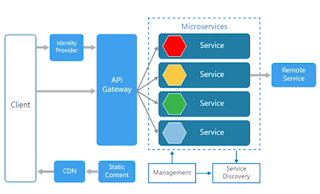
The Microservices Architecture is a software design pattern that organizes an application into a group of small, autonomous, loosely linked services. In the architecture, every service stands for a distinct business capability and interacts with other services via clearly defined message queues and APIs, allowing them to maintain their independence.
Fault isolation is further enhanced using a microservices design. A problem with one microservice won't always knock down the platform as a whole. Better dependability and simpler troubleshooting are made possible by this. We can maximize performance and take use of the advantages of "n" different programming languages and frameworks thanks to this flexibility.
Microservices in .Net Core
Developers design the entire platform as a single, huge application in the traditional monolithic way. Everything is handled by this monolithic approach, including friend and notification management, content submission, and user authentication. This configuration might function at first, but as the platform expands, it becomes more difficult to scale and maintain.
The Microservices architecture, on the other hand, offers a more flexible alternative. Rather than creating a single application, we can divide the Social Media Platform into discrete microservices, with each one handling a particular purpose.
Imagine having separate microservices for each of the following features: friendships, alerts, content uploading, user authentication, and many more
What is Monolithic Architecture?
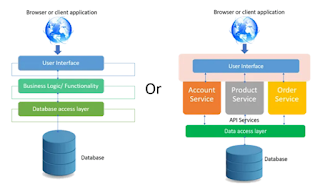
A classic application technique called monolithic architecture creates the entire program as one big, interconnected unit. Revisions or changes to the codebase may need time and work. Monolithics are easy to create at first, but as an application expands, they can be difficult to maintain and scale.
NIRA Systems helps you develop an application with Microservices Architecture with .Net Core
NIRA Systems is a leading software development company specializing in cutting edge solutions based on Microservices Architecture in .Net Core. Our team of experienced .Net Core Professionals collaborates closely with clients and ensures a transparent and cooperative environment where ideas flourish and innovations follow. By prioritizing outstanding client care and support, we provide cutting-edge solutions and unparalleled satisfaction. Put your trust in us for a game-changing experience where your software's success is based on a Microservices Architecture that takes center stage.
Conclusion
The .NET Core's Microservices Architecture opens up a world of possibilities for contemporary program development. Accept this paradigm, and you'll be able to realize the full potential of scalable, resilient, and effective applications with the help of a partner like NIRA Systems. So, as you set out on a trip toward a more promising future in software architecture, let innovation serve as your guide!
To know more contact us on
contact@nirasystems.com