

Ensure smooth transition, movement and analysis of the data for the best decision-making and retain your customers in this highly competitive world. Have secured and transparent data which is easy to analyse and evaluate for customer-related decision-making.
Salesforce Data Migration: Challenges and Best Practice
- July 30, 2024
- 7 min read
What is Salesforce Data Migration?
Salesforce is a digital CRM system that can store your client information cloud and can process it and store it to create best customer insight and this leads to customer satisfaction. It allows to store data, and it migrates existing customer data from present excel sheets or database to this digital CRM space. The source could be another platform, excel sheets, database and more. Salesforce data migration ensures to transfer customer customer-related data such as customer profiles, records, transactions, history, accounts, leads and other relevant information is securely transferred into the right sense to the right field in salesforce CRM. Salesforce CRM holds 18.7% of global CRM market as per data of 2022. The market value for CRM data migration is predicted around $33.58 billion by 2030.
Reasons for data migration
Various reasons make a business shift from old data sources and CRM to new Salesforce-based CRM. These include;
- Outgrown capacity of existing system: When your business grows and scales up your number of customers increases and the current database or CRM is not able to handle such rise with expected speed and performance then shifting to Salesforce is best.
- Cost optimisation: Salesforce has competitive pricing and its prices are low as compared to its innovative features. Salesforce provides a flexible product section where you just need to pay for the features you have selected.
- Can avoid host dealings: Salesforce deals with the server management and maintenance part of the digital space, and your business can focus on the core data analysis part for effective decision-making.
- Flexibility and scalability: You can easily choose from a range of products and features as per your unique business needs and it gets automatically adapted into the system, saves time and cost and reduces lag time or downtime.
Salesforce Data migration process
- Outline data model: The type of data, its processing, sources and the way to use are been briefed and described based on the business needs. What Salesforce templates, and features suit your needs, how to store them, and ways to retrieve them are been discussed.
- Data selection: Select the data which needs to be transferred to Salesforce, and ensure that only relevant data is transferred, and each data type is transferred from each source to avoid duplicates.
- Data cleansing: Ensure to remove and avoid duplicate, corrupted, unwanted and wrong-labelled data to avoid issues and confusion.
- Data migration: Salesforce provides a range of migration tools based on data types to transfer the data from the source to the CRM platform, and use them to transfer the actual data as mapped in the planning to the planned portals of CRM.
- Data validation: Validate the data before finalising by rechecking for duplicates and wrong data. At Nira systems we provide accurate testing systems to let you review and remove unwanted content and ensure safe and uncompromised data.
Data import Consideration
Importing data in the right manner is of great importance as the right data at the right point is useful, and thus data importing process during data migration in Salesforce needs to consider some points for a smooth transition. Importing data in right manner raises revenue, in FY2022, $26.4 billion revenue is generated with proper Salesforce data migration.
- Checkboxes: You can use 0 or 1 to verify the checked and unchecked values when the data is imported into the unchecked box.
- Date/Time formula fields: Set the same format you desired or the one set in the Salesforce to ensure the date and time are shown in the locale settings, always consider that the formula fields are ready only and cannot have imported data.
- Validations: Set and customise the validation rules based on the data you aim to import as based on these rules certain data which fails to pass the same is not imported. Consider turning it off.
- Default values: During import, the default value is to be set which will be shown when the data field is not mapped in the import wizard, and the same value will automatically be inserted into the record.
- Multi-select pick list: To import multiple values and data from the same source, use semicolons in the import files to separate various values and import data in the right manner.
Common challenges that need to be dealt with
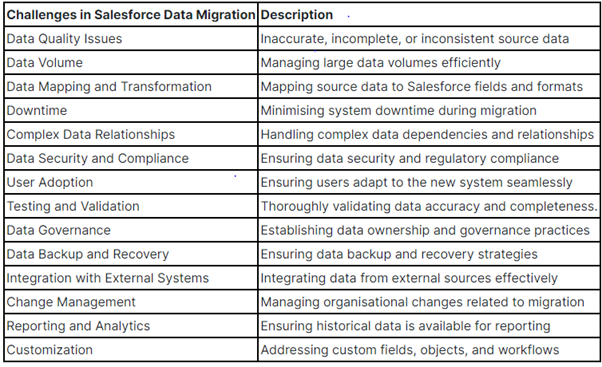
There are various challenges which are been faced by the businesses and data migration teams to Salesforce, and the planning for data migration needs to be done based on this. These are various challenges that create hurdles and these need to be managed.
- Adoption problems: It is hard for the users to adapt and shift to new systems to handle client data via CRM rather than via online portals, and thus the operations are new. The challenge is to train employees and make them habitual to it.
- Bad customer relations with wrong data exposure: If the data is not placed in the right manner in the data fields, it is shared in the wrong manner with clients and wrong customer analysis will be done and this could lead to blunders.
- Data analytics issue if data is not recorded in the right field: If the data is not recorded properly or is duplicated or has gaps with lack of information this could lead to wrong data analysis wrong decisions and dissatisfied customers.
- Lack of planning: Lack of planning of data usage filters that will be applied, data cases and more leads to more migration time and cost. This makes data migration harder to implement.
- Data complexity: Data could be complicated as data is triggered and works in specific data flows, and all of these need to be analysed while mapping the same in the Salesforce field.
- Upstream migration: lack of knowledge of how the existing data co-exist in upstream and downstream data and how it is related and used in various use cases thus it creates issues during actual migration as some data need to be linked in the manner they get updated or used simultaneously.
- Data Volume: The volume of data is one of the major issues where the volume decides the approach or migration tools to be used along with data formats and type, and thus having proper knowledge of its type and volume is important for migration.
- Data mapping: In case of diverse data about customers for various products and services, it is very important to map the data accurately in the right fields of Salesforce to ensure that the Salesforce reads the data in the same manner as expected, further labelling is right to have accurate and right data during extraction.
- Complex data relationships: Many a time the same data is used to create data for various other decisions, and thus the issue is in planning for mapping which ensures relations of such data and maintains relationships between them.
- Data security and compliance: Maintaining the security of data is of great importance though it is a challenge to migrate and import the data in a manner that is secured and safe from cyber threats. Based on local laws and systems it is a challenge to comply with data access, maintain privacy and store to extract it again.
- Testing and validation: Validating data for its effectiveness and testing it by various means is a challenge where testing various use cases, data extractions, extreme conditions for security and more needs to be done to ensure in each case CRM is effective to meet client needs. It needs detailed planning.
- Data backup and recovery practices: It is one of the major challenges to backup data and recover the data to other platforms or sources at times of natural disaster, cyber-attacks and more. Selection of the right platform in case of recovery and selection of important data to backup and keeping it updated is the major challenge and task.
- Integration with external systems: One of the major challenges is to turn and convert the data imported in a manner that can easily be converted, accessed and used by external systems, platforms and other web apps for effective and accurate decision-making. It is a challenge to plan the best way to have low-cost and effective formats which can be accessed by external apps.
- Change management: Managing change to change organisational structures, processes, procedures, employee behaviour, training and needs is a hard task as employees are resistant to change delayed change incurs costs and making employees get ready for change is a challenge.
Best Practices for Data Migration
To migrate the data there are some of the best things or practices are that that can be done to save time, and money and avoid errors in the first place.
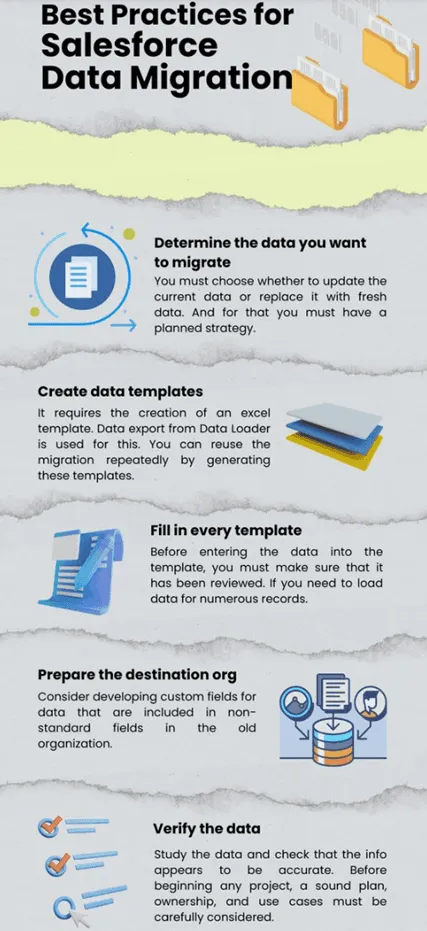
- Clear goals and objectives: It is one of the best practices where business owners must have clear goals and objectives about what customers to target, what services to provide, what sort of data to transfer, which tool to use, features to choose from Salesforce and more.
- Identify the data to be migrated: There is always a wide variety of data accumulated in the database, and it is important to identify the important, relevant and priority data and migrate it. Based on the size, type, format, needs, and market trends the data is to be selected.
- Create data templates: It is expected to create the data templates for various data categories to ensure the source and destinations have the same fields for easy data migration. It is about creating a template of what fields to create, with what headings and more.
- Plan in advance: Planning in advance is the best practice to identify the tools, budget, best Salesforce platform, timeline, data to transfer, objectives, customer service needs and more. To have the best plan in the way it takes time to implement and saves on cost.
- Data governance policy: Creating data governance guidelines allows to set of rules to use and transfer data, its access, roles in data migration for various employees, responsibilities, new roles and more makes it clear and transparent and thus employees are more dedicated to work with least errors or resistance.
- Data backup: Planning in advance for data backup options and ways is important as it allows low-cost alternatives and provides options to ensure security, data privacy, opting for what data to backup and more.
- Organise the data: Organised data allows for effective planning, mapping of fields and more and ensures to removal of duplicates. The organisation of data removes clustered data in the source. It saves time and cost. Salesforce is expected to grow at compounded 20% in next few years in terms of revenue.
- Preparing destination Salesforce: It is essential to customs Salesforce to create custom fields or some important headings which you want to carry the same from your source. Salesforce allows custom-creating fields. It is useful to have the same data points to directly transfer data from one folder to another between the source and Salesforce.
- Testing data migration: Testing the plan and the whole migration plan is of great importance as planning and practical are two different things. Running a pilot programme makes you use some demo data process it for migration and look for and improve potential errors.
- Finding the right Salesforce data migration tools: Data migration and its exports and imports and its capacity holding for several records or data needs to be considered to choose the best data migration tools. You can choose from the in-built Salesforce data import wizard up to 50000 records while the Salesforce data loader can process up to 5 million records and is available as an app on Windows and Mac while the Jitterbit data loader is a third-party application for more features.
Conclusion
Sales for data migration is of great importance as it provide great benefits to its users and your business by data analysis and supports in decision making. Salesforce is an online CRM platform, where data from existing sources needs to be migrated. There are certain challenges that needs to be managed to avoid customer dissatisfaction while some of the practices are recommended too perform for smooth transition of data such as correct mapping, selecting right migration tools and more.
With changing business environment selection of right data and platform to retain and attract clients is essential to survive in the market, and Salesforce CRM platform is the best to approach with Nira Systems. We are unique AI solution provider for all your business needs at affordable rates. Call Now to get amazed and kick start your success Journey. Click To Know More.
Developed by:
NIRA Systems - Collaboration Meets Innovation